
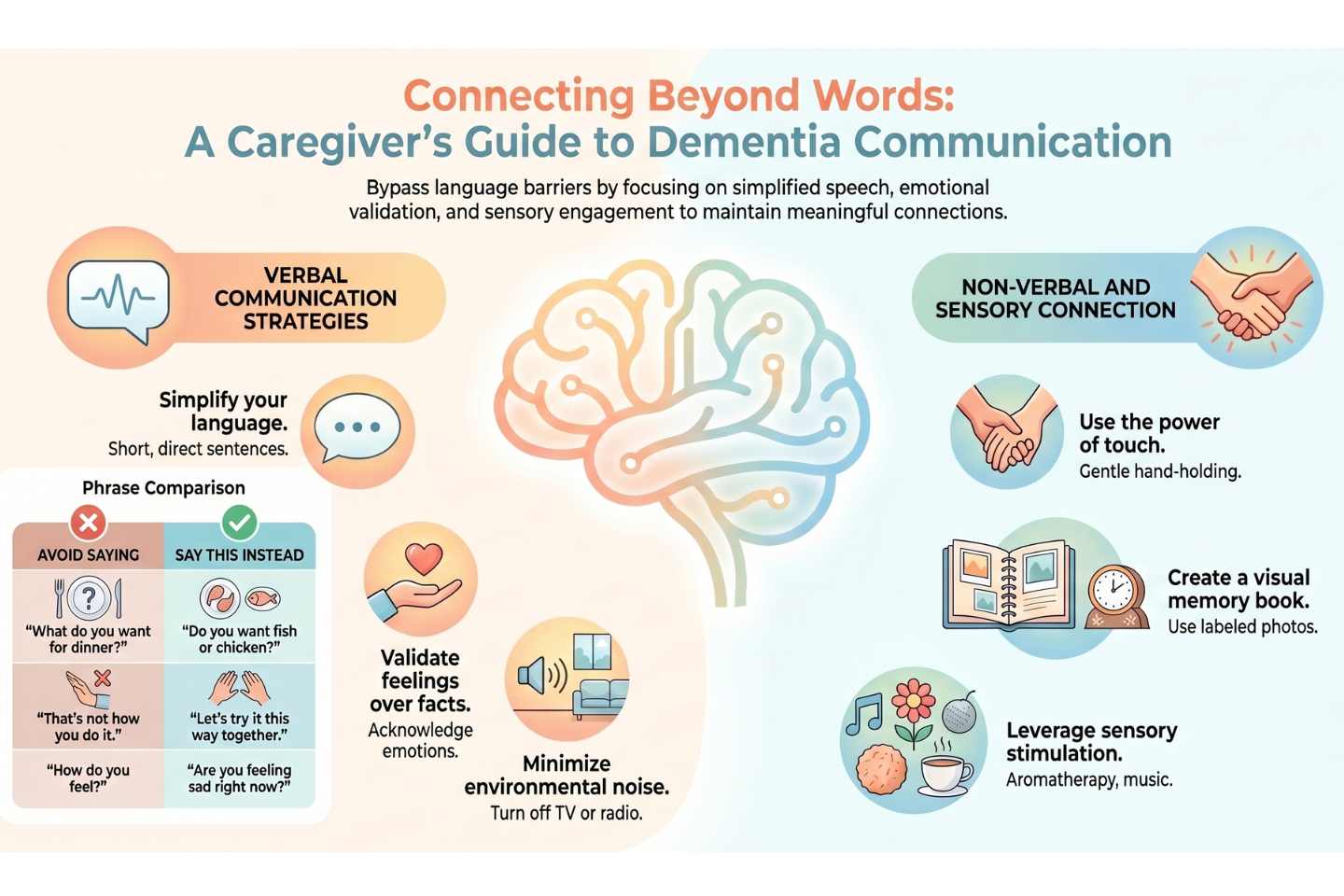
Handling Communication Challenges in Alzheimer’s: How to Stay Connected When Words Become Difficult
By The Olive Branch Medical — A Place of Love and Care for Those Living with Alzheimer’s and Dementia
Watching a loved one struggle to communicate can be deeply emotional. Conversations that once felt natural may now take more time, more patience, and sometimes feel confusing or incomplete. You may find yourself asking, “How do I connect with them now?”
If you are caring for someone with Alzheimer’s or dementia, you are not alone in feeling this way.
As the condition progresses, communication becomes more difficult. Words may be forgotten, sentences may not come out clearly, and understanding can fade. But even when language changes, the need for connection, comfort, and reassurance remains strong.
The good news is that connection is still possible. It simply takes a different approach.
In this guide, we will explore practical and compassionate ways to handle communication challenges in Alzheimer’s so you can continue to build meaningful moments with your loved one.
Why Communication Becomes Difficult in Alzheimer’s
Alzheimer’s affects the parts of the brain responsible for language and understanding. Over time, your loved one may:
- Struggle to find the right words
- Repeat themselves often
- Lose track of conversations
- Have difficulty understanding what is being said
- Use substitute words or phrases that may not make sense
This can lead to frustration for both of you.
It is important to remember that your loved one is not being difficult on purpose. They are doing their best with the changes happening in their brain.
💡 Key insight: Communication is more than words. Tone, body language, and emotional connection matter just as much.
Simple Techniques to Improve Communication
When words become difficult, small adjustments in how you communicate can make a big difference.
- Keep sentences short and clear
Use simple language and speak slowly. Instead of long explanations, break things into small, easy steps.
For example:
Say “Let’s sit down” instead of “Why don’t we go over to the couch and sit for a bit?”
- Ask one question at a time
Too many questions can feel overwhelming. Keep it simple and give them time to respond.
Instead of asking, “Do you want tea or coffee or juice?”
Try asking, “Would you like tea?”
- Be patient with responses
Give your loved one time to process and reply. Silence can feel uncomfortable, but rushing them may increase anxiety.
- Avoid correcting or arguing
If they say something incorrect, it is often better to go along with it or gently redirect. Correcting them may lead to frustration or embarrassment.
- Use names and familiar words
Using familiar names and simple terms can help reduce confusion and make conversations easier to follow.
The Power of Non Verbal Communication
When words become harder to use, non verbal communication becomes even more important.
Ways to connect without relying on words
- Maintain gentle eye contact
- Smile often and offer reassurance
- Use a calm and friendly tone
- Hold their hand or offer a comforting touch
- Use gestures to support your words
Sometimes, a warm smile or a reassuring touch can communicate more than a full sentence.
Handling Confusion and Misunderstandings
There will be moments when your loved one seems confused or misunderstands what you are saying. These situations can be challenging, but how you respond makes all the difference.
Helpful approaches
Stay calm and reassuring
Your energy sets the tone. If you stay relaxed, they are more likely to feel at ease.
Repeat gently if needed
Use the same words rather than changing your sentence, as new wording may cause more confusion.
Redirect the conversation
If frustration builds, shift focus to something comforting like music, a photo, or a familiar activity.
Validate their feelings
Even if what they are saying does not make sense, their emotions are real. Respond to how they feel rather than correcting facts.
Example:
Instead of saying, “That is not true,” try “I can see that this is upsetting for you.”
Supporting Someone Who Struggles to Speak
As Alzheimer’s progresses, your loved one may speak less or stop speaking altogether. This can feel like a loss, but connection is still possible.
Ways to stay connected
- Sit together in a calm space
- Listen to their favorite music
- Look through old photos together
- Engage in simple activities like folding laundry or gardening
- Pay attention to facial expressions and body language
Even quiet moments can be meaningful. Presence matters more than perfect conversation.
Creating a Communication Friendly Environment
The environment around you plays a big role in how well communication flows.
Try to:
- Reduce background noise such as television or loud conversations
- Choose quiet, familiar spaces for interaction
- Maintain a consistent daily routine
- Keep distractions to a minimum
A calm setting can help your loved one focus and feel more comfortable.
Caring for Yourself as a Caregiver
Communication challenges can be emotionally draining. It is okay to feel frustrated, tired, or even sad at times.
Taking care of yourself is not selfish. It is necessary.
Simple ways to support yourself
- Take short breaks when needed
- Talk to someone you trust about how you feel
- Join a caregiver support group
- Seek professional guidance when things feel overwhelming
You are doing important work, and your wellbeing matters too.
How The Olive Branch Medical Can Help
At The Olive Branch Medical, we understand how deeply communication challenges can affect both patients and families. These moments can feel isolating, but you do not have to face them alone.
Based in South Africa, we provide compassionate and specialized care for individuals living with Alzheimer’s and dementia.
Our team is here to:
- Support meaningful communication between you and your loved one
- Offer practical guidance tailored to your situation
- Provide a safe and caring environment
- Help reduce stress for both patients and families
We believe that even when words fade, connection should never be lost.
Frequently Asked Questions
How can I communicate better with someone who has Alzheimer’s?
Use simple language, speak slowly, and be patient. Focus on tone, body language, and emotional reassurance as much as words.
What should I do if my loved one cannot find the right words?
Give them time, avoid interrupting, and gently support them. If needed, try to guess the word or shift to a different way of communicating.
Is it okay to correct someone with dementia?
In most cases, it is better not to correct them. Instead, respond to their emotions and gently guide the conversation.
Can non verbal communication really help?
Yes, it can be very powerful. Eye contact, touch, and tone often communicate more effectively than words in later stages of dementia.
Final Thoughts
Handling communication challenges in Alzheimer’s is not about finding the perfect words. It is about adapting, being present, and showing compassion in new ways.
There will be moments of difficulty, but there will also be moments of connection that are just as meaningful, even without words.
With patience, understanding, and the right support, you can continue to build a strong and loving connection with your loved one.
And when you need guidance, reassurance, or professional care, The Olive Branch Medical is here to walk this journey with you, every step of the way.
Qualified Staff and Support
Our entire team are qualified to handle patients who have Alzheimer’s and Dementia.
Our dedicated team is our greatest asset, and they are extremely caring and loving towards all patients. They are on duty 24 hours a day, and our live-in matron is there to support our patients and their families.
Visit our Contact Page to book a tour – HERE